

If you’ve been seriously injured in Lafayette, you’re probably dealing with medical bills, missed work, and an insurance company that’s already trying to minimise what they owe you. You need a lawyer — but you also need the right one. This page explains what a personal injury lawyer actually does for you, what your case may be worth, and what to look for when making this decision. Louisiana personal injury law is different from most other states — it has a shorter deadline to file, a different approach to shared fault, and a unique civil law tradition that affects how cases are argued. These differences matter, and they’re reasons to work with a Lafayette attorney who knows the local courts, local insurers, and local judges.
What Counts as a Personal Injury Case in Louisiana?

Personal injury is a legal term for any injury caused by another person’s negligence, recklessness, or intentional act. If someone else’s actions — or failure to act — caused your injury, you may have the right to compensation. The following case types fall under personal injury law in Louisiana:
- Car accidents: The most common personal injury case in Louisiana. Whether it’s a rear-end collision on I-10, a red-light violation on Johnston Street, or a multi-vehicle crash on I-49, we handle the full claims process — including uninsured motorist situations.
- Truck accidents: Crashes involving 18-wheelers, commercial trucks, or delivery vehicles involve federal FMCSA regulations and often multiple liable parties. These cases require early evidence preservation, including black box data and driver logs.
- Slip and fall accidents: Property owners in Louisiana have a duty to maintain safe premises. If you were injured on someone else’s property due to a hazardous condition they knew about — or should have known about — you may have a premises liability claim.
- Motorcycle accidents: Motorcycle riders face disproportionate injury severity in crashes. Louisiana’s helmet laws and lane-splitting rules affect liability in ways that require local knowledge.
- Wrongful death: When a negligent act causes someone’s death, the surviving family members may bring a wrongful death claim. Louisiana law defines who can file and what damages are available.
- Workers’ compensation: If you were injured on the job, Louisiana’s workers’ compensation system provides benefits — but those benefits are limited. In some cases, a third-party personal injury claim is also available alongside workers’ comp.
- Dog bites: Louisiana holds dog owners strictly liable for bites in most circumstances. You do not need to prove the dog had a history of aggression.
- Maritime and offshore injury: Louisiana’s Gulf Coast economy means offshore and maritime injuries are common. These cases are governed by federal maritime law (the Jones Act) rather than state law, and require a lawyer with specific experience in this area.
- Medical malpractice: Louisiana has a Medical Malpractice Act that caps damages and requires a medical review panel before filing suit. These cases require expert witnesses and early case preparation.
- Premises liability: Covers a broader range of property-related injuries beyond slip and fall — including inadequate security, swimming pool accidents, and structural failures.
If you’re not sure whether your situation qualifies, the best step is a free consultation. Kenny will give you an honest assessment — including if he believes you don’t have a viable claim.
How Louisiana Personal Injury Law Works
Louisiana has some of the most distinctive personal injury laws in the United States. Understanding these rules is not just useful background — it directly affects your rights and your strategy.
Pure Comparative Fault (Louisiana Civil Code Art. 2323)
Louisiana is a pure comparative fault state. This means you can recover compensation even if you were partly responsible for the accident — your recovery is simply reduced by your percentage of fault. Example: if your total damages are $100,000 and you were found 25% at fault, you can still recover $75,000. Even if you were 99% at fault, you could theoretically recover 1% of your damages — though in practice, cases with significant shared fault are harder to settle. Insurance companies use comparative fault aggressively. Their adjusters are trained to find reasons to inflate your share of blame. An experienced personal injury lawyer prevents this by controlling the narrative from the start.
Louisiana’s 1-Year Statute of Limitations
Louisiana Civil Code Article 3492 gives injury victims only one year from the date of injury to file a personal injury lawsuit. This is one of the shortest filing deadlines in the United States. Most other states allow two to three years. Missing this deadline means permanently losing your right to compensation — regardless of how strong your case is. There is no exception for not knowing you had a claim.
Limited exceptions to the one-year rule:
- Minors: the one-year period begins on the victim’s 18th birthday
- Discovery rule: for injuries that were not immediately apparent (such as some toxic exposure cases), the clock may start when the injury was discovered or should have been discovered
- Claims against government entities: an additional requirement applies — you must file a written notice of claim within 90 days of the injury before you can sue
- Wrongful death: one year from the date of death, not the date of the accident that caused it
Do not wait to consult a lawyer. Evidence degrades, witnesses’ memories fade, and insurance companies use delay against you.
Louisiana’s Civil Law System
Louisiana is the only US state that operates under a civil law system derived from the Napoleonic Code, rather than the English common law tradition used by the other 49 states. This affects how damages are calculated, how legal arguments are structured, and how courts interpret fault. It is a genuine reason to work with a Louisiana-based lawyer rather than a national firm that may not be familiar with the state’s legal framework.
What Your Personal Injury Case May Be Worth
Every case is different, and any lawyer who gives you a specific number before reviewing your medical records and the full facts of your case is not being straight with you. That said, the following framework explains how damages are calculated in Louisiana personal injury cases.
Economic Damages
These are calculable losses with a specific dollar value:
- Medical expenses: All past treatment costs plus estimated future treatment — surgeries, physical therapy, specialist visits, medications, assistive devices. Future medical costs are established through expert medical opinion.
- Lost wages: Income lost during your recovery period, documented through pay stubs and employer confirmation.
- Loss of earning capacity: If your injury permanently reduces your ability to earn at the same level, an economist can calculate the long-term income impact.
- Property damage: Vehicle repair or replacement, plus any personal property damaged in the accident.
- Out-of-pocket expenses: Transportation to medical appointments, home care costs, and other direct expenses caused by the injury.
Non-Economic Damages
Louisiana does not cap non-economic damages in most personal injury cases. This is a meaningful advantage over states like Texas or California that impose hard caps on pain and suffering awards.
- Pain and suffering: Physical pain, both past and ongoing.
- Emotional distress: Anxiety, depression, PTSD, and psychological trauma resulting from the injury.
- Loss of enjoyment of life: The impact of the injury on your ability to participate in activities you previously enjoyed.
- Loss of consortium: The effect on your relationship with your spouse, including companionship and intimacy.
Typical Settlement Ranges by Injury Type
These ranges are illustrative only. Actual settlement values depend on the specific facts, severity, and liability picture of each case.
- Soft tissue injuries (whiplash, sprains): $15,000 – $75,000 • Broken bones: $50,000 – $250,000
- Traumatic brain injury: $150,000 – $2M+
- Spinal cord injury: $500,000 – $5M+
- Wrongful death: $500,000 – $3M+
Key factors that affect settlement value:
- Severity and permanence of the injury • Clarity of liability — how clearly the other party was at fault
- Insurance policy limits of the at-fault party
- Quality of your medical documentation
- Whether you missed work and for how long
- Pre-existing conditions (these can complicate but do not prevent a claim)
- Whether punitive damages apply (drunk driving, intentional acts, certain product defects)
What a Personal Injury Lawyer Actually Does for You
Many injury victims try to handle insurance claims on their own. Insurance companies know this and take advantage of it. Here is what a personal injury lawyer does that you cannot effectively do without one.
Investigates the accident independently
Obtains police reports, surveillance footage, witness statements, and expert opinions. Sends spoliation letters to preserve evidence before it is destroyed or overwritten — including black box data, which may be overwritten within 30 days.
Handles all communication with insurance companies
You do not speak to the at-fault driver’s insurer without your lawyer’s involvement. Recorded statements made before you have legal advice are frequently used to reduce your claim.
Documents the full value of your damages
Works with medical providers to document current and future treatment costs. Engages vocational and economic experts when needed to calculate long-term earning losses.
Negotiates a fair settlement
Most personal injury cases settle without going to trial. A lawyer with trial experience gets better settlements because the insurance company knows they will fight if necessary.
Goes to trial when required
If the insurance company refuses to offer fair compensation, Kenny will file suit and take the case to a Lafayette Parish jury. The credible threat of litigation is often what produces a fair offer.
Handles the logistics
Medical bill negotiations, lien resolution with health insurers, settlement disbursement — your lawyer manages the process so you can focus on recovery.
The Contingency Fee Model: No Upfront Cost
Kenny Habetz works on a contingency fee basis. There are no hourly fees and no upfront costs. His fee is a percentage of the compensation recovered — typically 33.3% for pre-suit settlements and 40% if the case goes into litigation. If no compensation is recovered, you owe nothing. This structure means Kenny’s financial interests are aligned with yours: the better your outcome, the better his fee. He has no incentive to settle quickly for less than your case is worth.
What to Look for When Choosing a Personal Injury Lawyer in Lafayette
Not all personal injury firms are the same. Here are the criteria that actually matter — and why they apply to your decision.
Trial Experience vs. Settlement Mills
Some high-volume personal injury firms settle every case quickly to maximise throughput. Insurance companies know exactly which firms will never go to trial — and they calibrate their offers accordingly. A lawyer with genuine trial experience receives better settlement offers because the insurer knows that a lowball offer will be rejected and the case will go to a jury. Kenny Habetz has jury trial experience in Lafayette Parish courts.
Local Knowledge
Lafayette-specific knowledge matters at every stage of a personal injury case. Familiarity with the intersections and roads where accidents happen — I-10, I-49, Ambassador Caffery Parkway, Johnston Street — informs how accident reconstruction is approached. Knowledge of local judges and court procedures shapes litigation strategy. Relationships with local medical providers who can provide credible expert testimony strengthen your case at trial.
Direct Access to Your Lawyer
At large national firms, your case is often handled day-to-day by a paralegal, and you speak to an attorney only at key milestones. At Kenny Habetz Injury Law, you work directly with Kenny. This means faster communication, better case continuity, and a lawyer who knows the details of your case when the insurance company calls.
The Personal Injury Claims Process in Louisiana — Step by Step
Understanding what happens — and in what order — reduces anxiety and helps you make better decisions throughout the process.
1. Free Consultation (Day 1)
Tell Kenny what happened. He evaluates whether you have a viable claim, what it may be worth, and what the path forward looks like. There is no charge for this and no obligation to proceed.
2. Investigation (Weeks 1–4)
Gathering and preserving evidence: accident reports, medical records, witness statements, photographs, surveillance footage, black box data where available. Spoliation letters are sent to relevant parties to prevent destruction of evidence.
3. Medical Treatment
You continue treating with your doctors. It is critical that you do not agree to a settlement before reaching maximum medical improvement (MMI) — the point at which your condition has stabilised. Settling too early is the single most common mistake injury victims make, because future treatment costs cannot be recovered once a settlement is signed.
4. Demand Letter (Typically 1–3 Months After MMI)
Kenny sends a formal demand letter to the insurance company documenting all damages — medical expenses, lost wages, pain and suffering — and the compensation sought. This opens formal negotiations.
5. Negotiation (Typically 1–3 Months)
Most cases settle at this stage. Kenny negotiates directly with the insurance adjuster. You are informed of every offer and must approve any settlement before it is accepted. Kenny’s advice will include whether an offer is fair relative to your damages and the risk of litigation.
6. Litigation (If No Fair Settlement Is Reached)
Kenny files suit in Lafayette Parish district court. Filing suit does not automatically mean a trial — the majority of litigated cases still settle before a jury is empanelled. But filing demonstrates credibly that you are prepared to fight, which typically produces a better offer.
7. Trial (If Necessary)
If the case proceeds to trial, Kenny presents your case to a Lafayette jury. A verdict in your favour is legally binding on the insurance company.
8. Resolution and Disbursement
You receive your settlement or verdict amount, minus Kenny’s contingency fee, case costs, and any outstanding medical liens. Kenny’s office handles lien negotiation with health insurers to maximise your net recovery.
Timeline: Most straightforward cases that settle without litigation resolve in 6–18 months. Cases involving severe injuries, disputed liability, or litigation can take 2–3 years.
Frequently Asked Questions
How long do I have to file a personal injury claim in Louisiana?
One year from the date of the injury, under Louisiana Civil Code Article 3492. This is one of the shortest deadlines in the US. Missing it means permanently losing your right to compensation. Limited exceptions apply for minors, latent injuries, and claims against government entities. Do not wait to get legal advice.
What if I was partly at fault for the accident?
You can still recover compensation. Louisiana’s pure comparative fault law means your recovery is reduced by your percentage of fault — not eliminated. If you were 30% at fault and your damages are $100,000, you can recover $70,000. Insurance companies routinely inflate the victim’s share of fault to reduce payouts. An attorney prevents this.
How much does a personal injury lawyer cost in Lafayette?
Kenny works on a contingency fee basis — no upfront fees, no hourly billing. His fee is a percentage of the compensation recovered (typically 33.3% pre-suit, 40% if the case goes into litigation). If no compensation is recovered, you owe nothing.
Do I have to go to court?
Most personal injury cases in Louisiana settle without going to trial. However, having a lawyer who is genuinely prepared to go to trial — and who the insurance company knows will go to trial — typically produces better settlement offers than working with a firm that consistently settles.
What if the at-fault driver doesn’t have insurance?
Louisiana requires drivers to carry minimum liability insurance, but many don’t. If the at-fault driver is uninsured or underinsured, your own uninsured motorist (UM) coverage may apply. Louisiana law gives you the right to reject UM coverage in writing — if you didn’t sign a written rejection, you likely have it. Kenny can review your policy and advise on all available recovery options.
Should I accept the insurance company’s first offer?
Almost never. First offers are routinely below the actual value of the claim — sometimes significantly so. Insurance companies make early offers because statistically, some unrepresented claimants accept them without understanding what their case is actually worth. A lawyer reviews any offer against your documented damages before advising you whether to accept.
How long does a personal injury case take in Louisiana?
Straightforward cases that settle before litigation typically resolve in 6–18 months. Cases that go to litigation can take 2–3 years, depending on court scheduling and the complexity of the facts. Cases involving catastrophic injuries or disputed liability tend to take longer. Kenny will give you a realistic timeline assessment during your consultation.
What should I do immediately after an accident in Lafayette?
Call 911 and obtain a police report. Seek medical attention immediately, even if you feel fine — injuries including head trauma and soft tissue damage may not be immediately apparent, and delayed treatment is used by insurers to dispute the severity of your injuries. Do not give a recorded statement to any insurance company before speaking to a lawyer. Take photographs of the scene, your injuries, and any vehicle damage. Then call Kenny Habetz Injury Law.
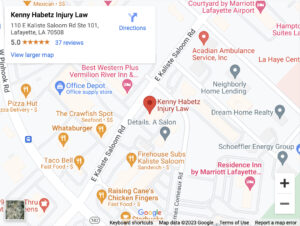
Kenny Habetz Injury Law
110 E Kaliste Saloom Rd, Suite 101
Lafayette, LA 70508
Phone: (337) 399-9000
Hours: Open 24 hours daily
Get Directions in Google Maps
Testimonials

See more of our Google Reviews.
Talk to a Lafayette Personal Injury Lawyer Today
If you’ve been injured in Lafayette through someone else’s negligence, you have legal options — and a one-year deadline to act. Every day that passes makes evidence harder to obtain and memories harder to verify. Kenny Habetz offers free, no-obligation consultations. He’ll tell you honestly whether you have a viable claim, what it may be worth, and what the process looks like. There is no fee unless we win.